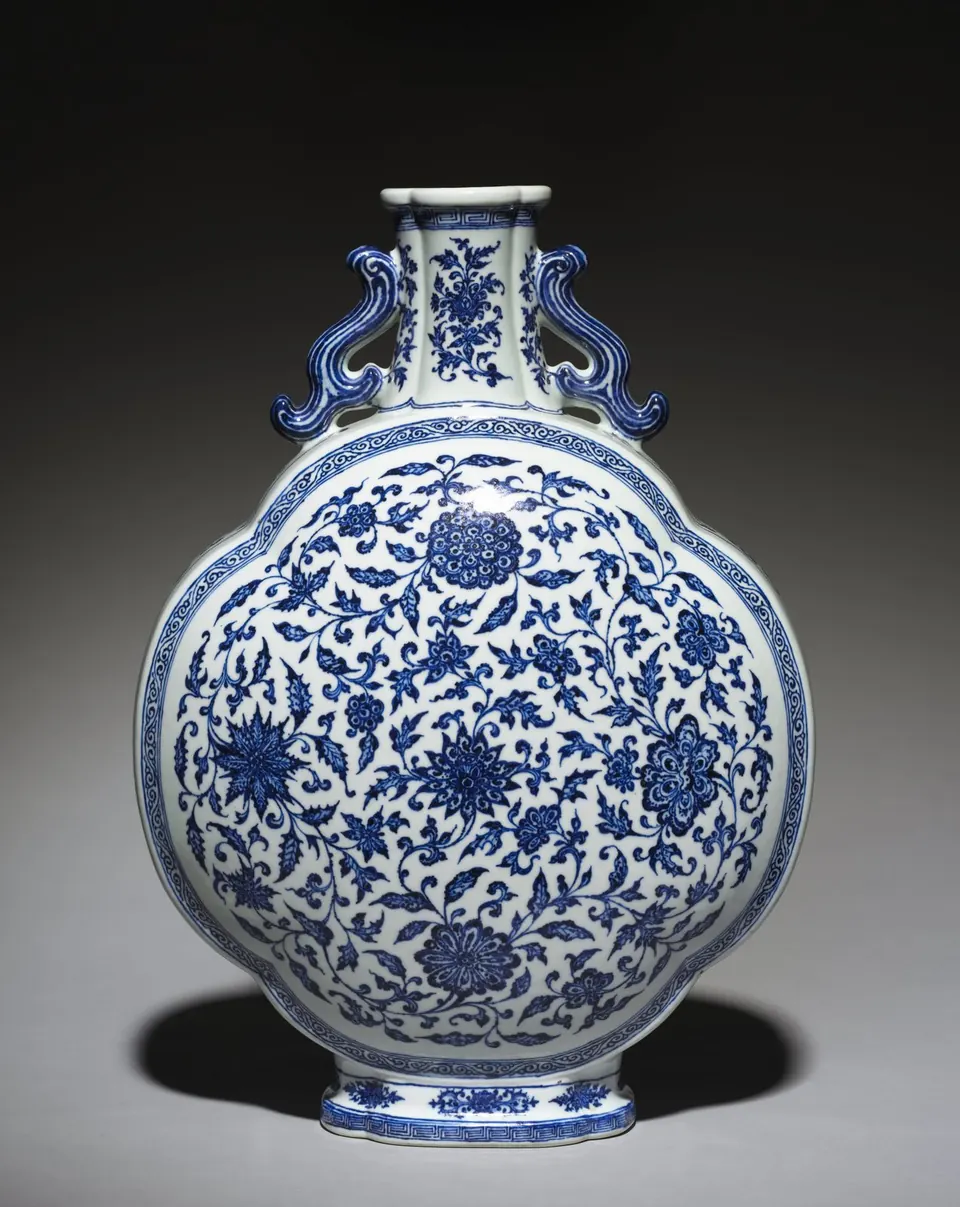
Cleveland Museum of Art · 1964.226 · CC0 public domain · museum page

Learn
Blue and White Porcelain Patterns - Motif Guide
Updated 2026-11-12
Blue and white porcelain patterns are designs painted in cobalt blue on a white porcelain body, usually with a brush, under a clear glaze[1]. Two colours only, yet every motif carries a meaning, from lotus and peony to plum, bamboo and fish, and each has its usual place on the pot. This guide picks the most common blue and white porcelain patterns, gives a museum source for every meaning, and shows how to put them together into a piece of your own.
How blue and white porcelain patterns are fired
- Paint: the cobalt design goes onto the porcelain before glazing[2].
- Glaze: a clear glaze is laid over it.
- Fire: at high temperature. The Asian Art Museum in San Francisco notes that only cobalt could withstand the heat that turns the glaze into glass[2]; the V&A gives a range of 1280–1350 °C[3].
Get the kiln wrong and the blue can turn greyish black; the V&A owns a Xuande vase that misfired exactly this way[6].
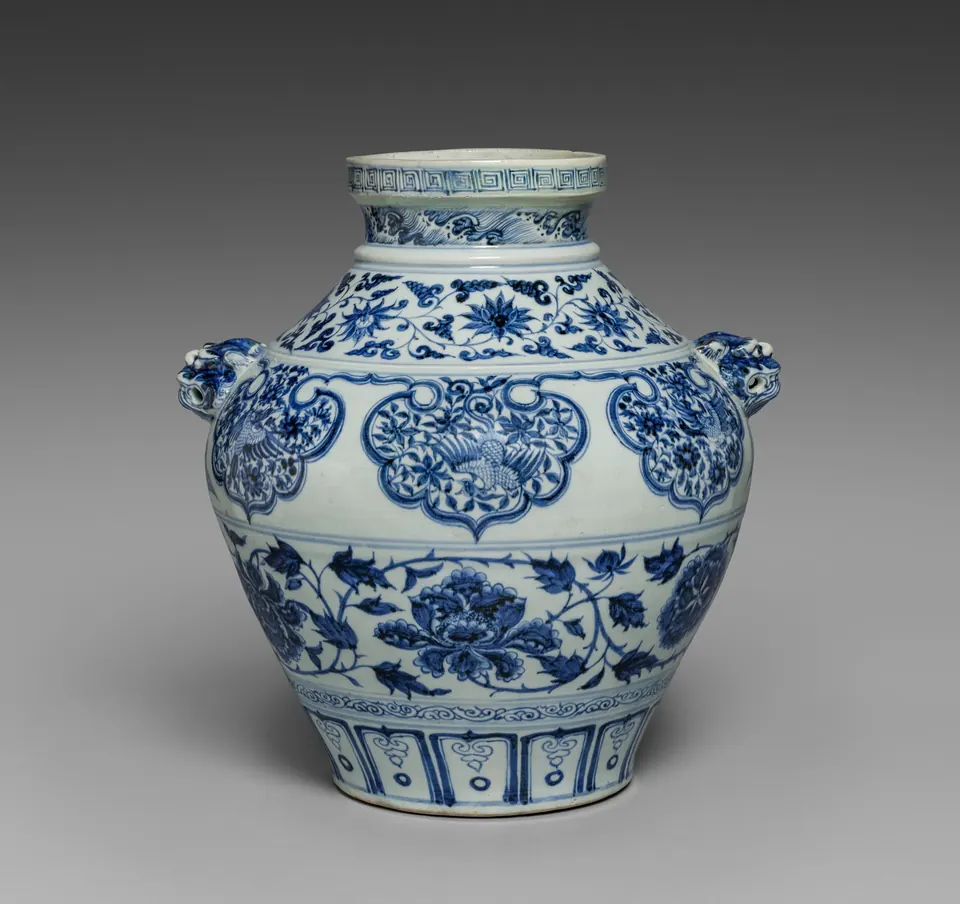
Where did the cobalt come from? Chinese potters briefly tried cobalt blue as early as the ninth century, but blue-and-white took off under Mongol rule in the fourteenth, when the Middle East was the main source of the pigment[4]. Cleveland’s Yuan jar with lion-head handles was painted with cobalt "imported from Iran, likely from Kashan"[5]. In the second half of the fifteenth century a native supply was found[4].
Common blue and white porcelain patterns and their meanings
Every pattern below is YinSeal’s own redrawing of a traditional motif, ready to use in the blue-and-white studio. Meanings appear only where we have a source (tap "Source" for the museum’s own words); a card without one means we found nothing reliable.
- Lotus scroll缠枝莲Meaning:The lotus is a symbol of purity, popular with Chinese literati and in Buddhism. Source
- Bamboo竹Meaning:Pine, bamboo and plum are the "Three Friends" of winter, metaphors for the scholar’s integrity, endurance and purity. Source
- Fish and waterweed鱼藻Meaning:The word for fish (yú) sounds like "abundance", so the motif is auspicious. Source
- Ruyi cloud collar如意云头纹Meaning:Ruyi means "as one wishes" and conveys blessings of wish fulfillment. Source
- Key fret回纹
- Upright lotus petals仰莲纹Meaning:The lotus is a symbol of purity, popular with Chinese literati and in Buddhism. Source
- Sea waves海水纹
- Scrolling vine卷草纹
- Moon and plum (from a museum piece)月梅纹(文物取样)Drawn from:Traced from the centre of a Chenghua-period dish in the Met (1981.81.1). Source
- Floral scroll (from a museum piece)缠枝花卉纹(文物取样)Drawn from:Traced from a Yongzheng flask whose body, the museum says, is decorated with lotus and other flowers, leaves and scrolling tendrils. Source
The sources in brief: the lotus "is a symbol of purity and popular among Chinese literati and in Buddhism"[7]; the peony symbolizes "wealth and honor"[8]; pine, bamboo and plum are the "Three Friends" of winter, standing for the scholar’s integrity, endurance and purity[9]; the plum "symbolizes the winter season and is a harbinger of spring"[10]; fish, yú, sounds like "abundance"[11]; ruyi means "as one wishes"[12].
The key fret is the exception. Museums record it as a "key band" and give it no meaning, and the popular explanations online have no source we could find, so we leave it as a border.
Where the patterns go: main design and bands
A blue-and-white piece is usually built from a main design and bands:
- The main design fills the largest surface: lotus or peony scrolls, the Three Friends, fish, figures. The V&A’s Xuande meiping has "a lotus scroll undulating around the main body"[6].
- Bands go on the narrow places: rim, neck, shoulder and foot. The Freer Gallery describes a bowl from the first Ming reign as decorated with "peony, lotus and fungus scrolls, key bands and formal lotus leaf band"[13].
- The cloud collar on the shoulder: Cleveland’s Yuan jar has a band of ruyi-shaped cloud collars with phoenixes, a vocabulary the museum notes is also found in Iranian art of the same period[5].
A band is one motif repeated round the pot, in other words a frieze pattern. Set the bands first, then the main design, and the structure of the piece is done.
Reading the mark and the shape
- Reign marks: from the Yongle reign, official wares began to bear the emperor’s reign mark, according to the National Palace Museum in Taipei[18]; the Freer adds that marks written in cobalt under the glaze first became common on imperial wares in the Xuande period, though they were not mandatory[19]. Cleveland’s Three Friends bowl is inscribed 大明宣德年製, "Made in the Great Ming dynasty, Xuande reign"[9]. Marks were also copied: a meiping at Hillwood carries a Xuande mark "but it is not of the period"[20].
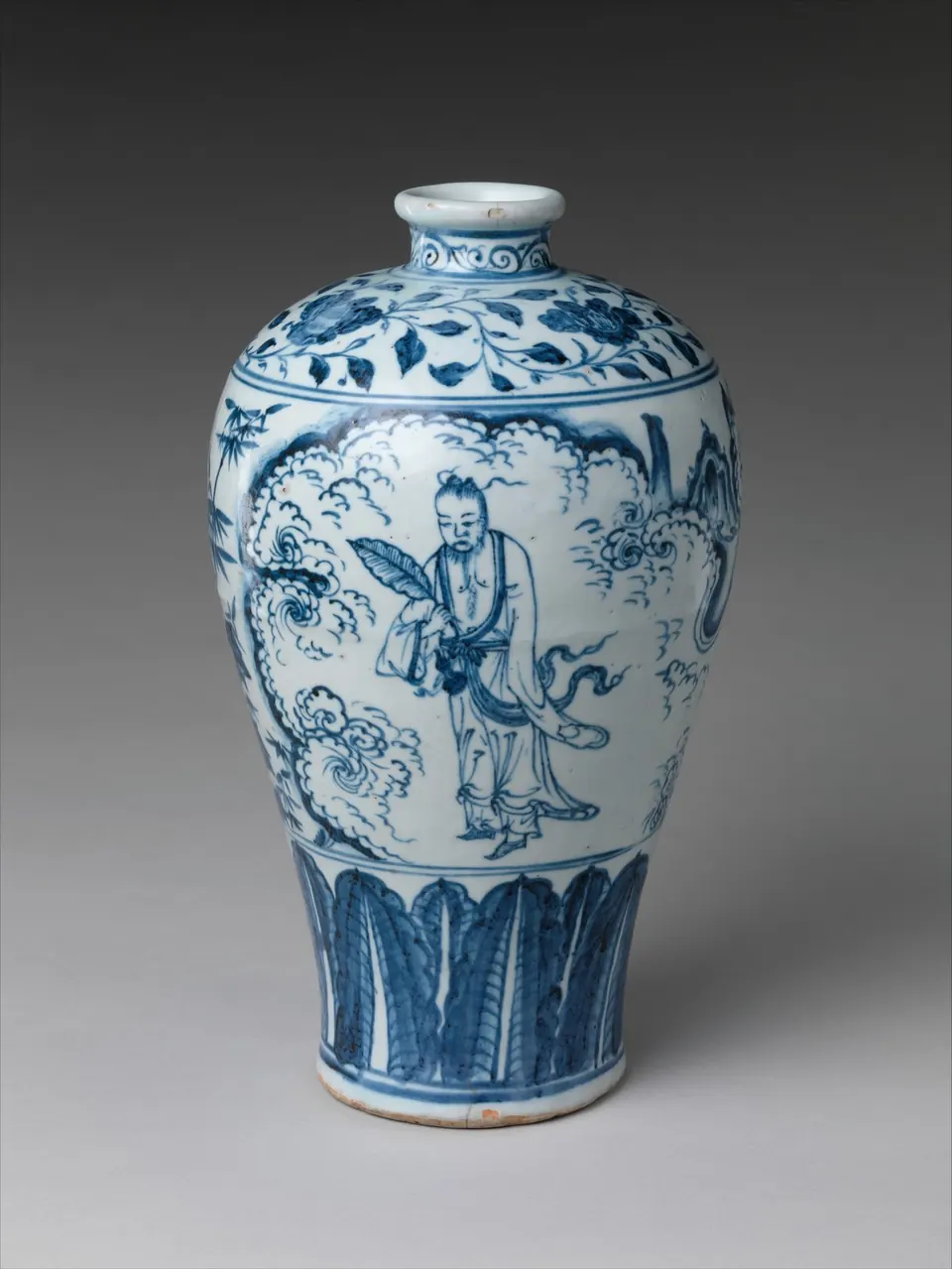
- The meiping: the name means "prunus vase", from displaying a single spray of blossoming plum[21]. Vases of this shape "originally served as wine containers"[22], and the V&A notes that the term meiping was coined much later[23].
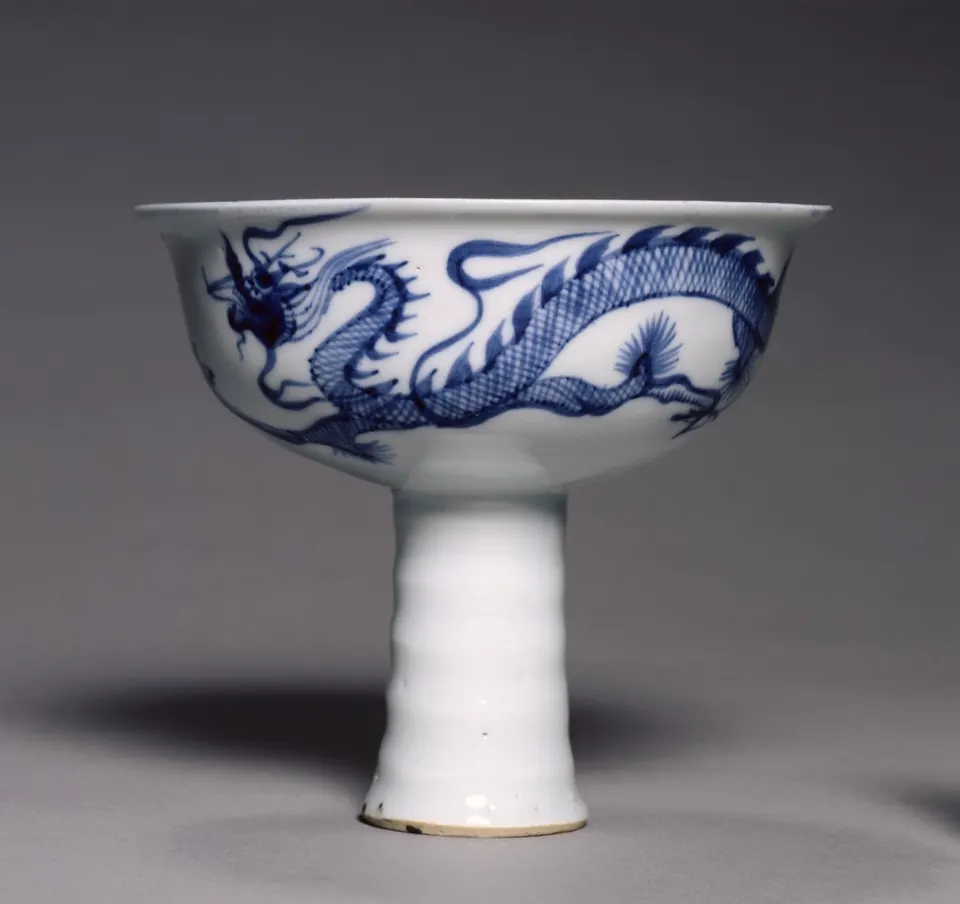
Blue and white porcelain patterns on real objects
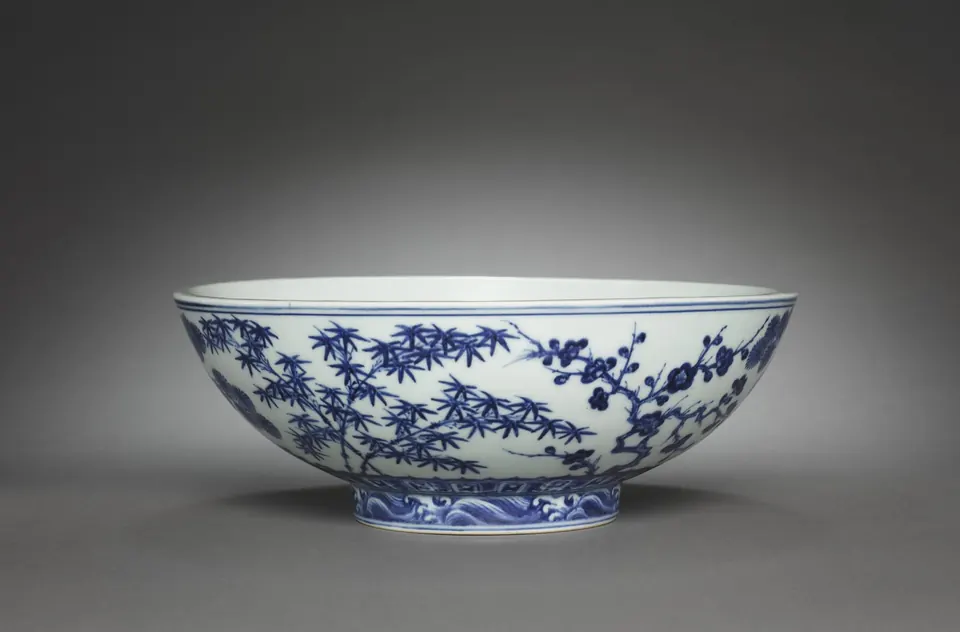
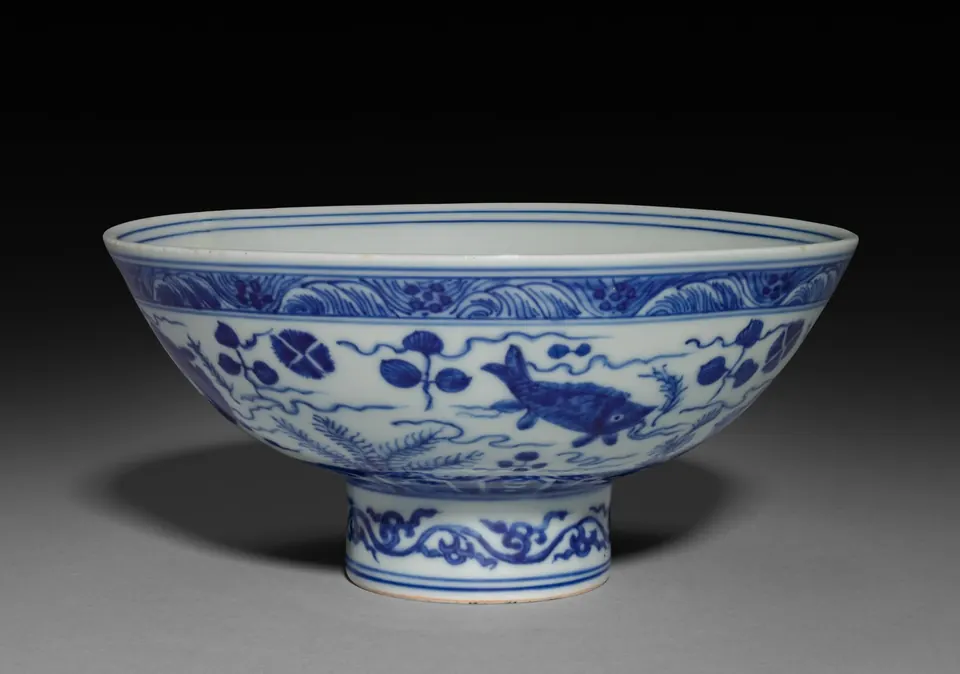
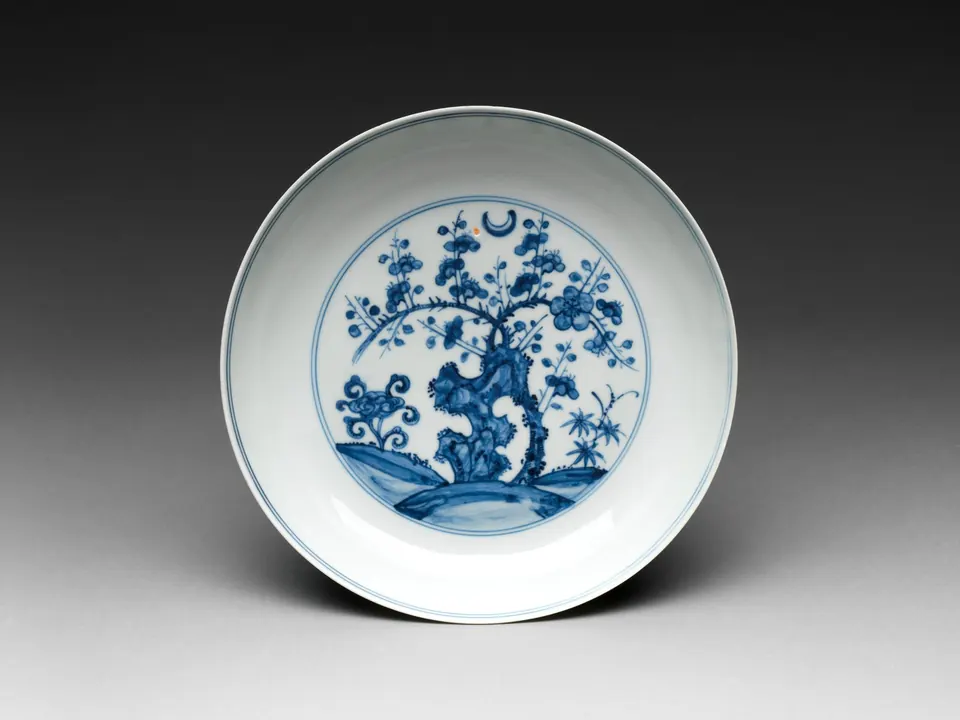
Blue and white goes global
- Export: blue-and-white went to Japan, Korea, Southeast Asia and as far as Africa[1]. Cleveland’s Yongle grape plate was "made primarily for export to southeastern and western Asia"[14].
- Kraak porcelain: an export type with panelled borders made from the 1580s to the 1640s; kraak is the Dutch name for the carrack, an ocean-going ship[15].
- Delftware: Dutch potters competed with Chinese porcelain by painting Chinese-style designs in cobalt on white tin glaze[16].
- Willow Pattern: an English design developed around 1800; its "Chinese" love story was invented later[17].
Design your own piece in five steps
- Pick a blank: a meiping, pear vase, plate, bowl, or a T-shirt, robe or fan. Start with a meiping.
- Main design on the body: one of lotus scroll, plum branch or fish. Do not overload it.
- Bands on the rim and foot: key fret, lotus petals or waves, or make your own in the Pattern Lab.
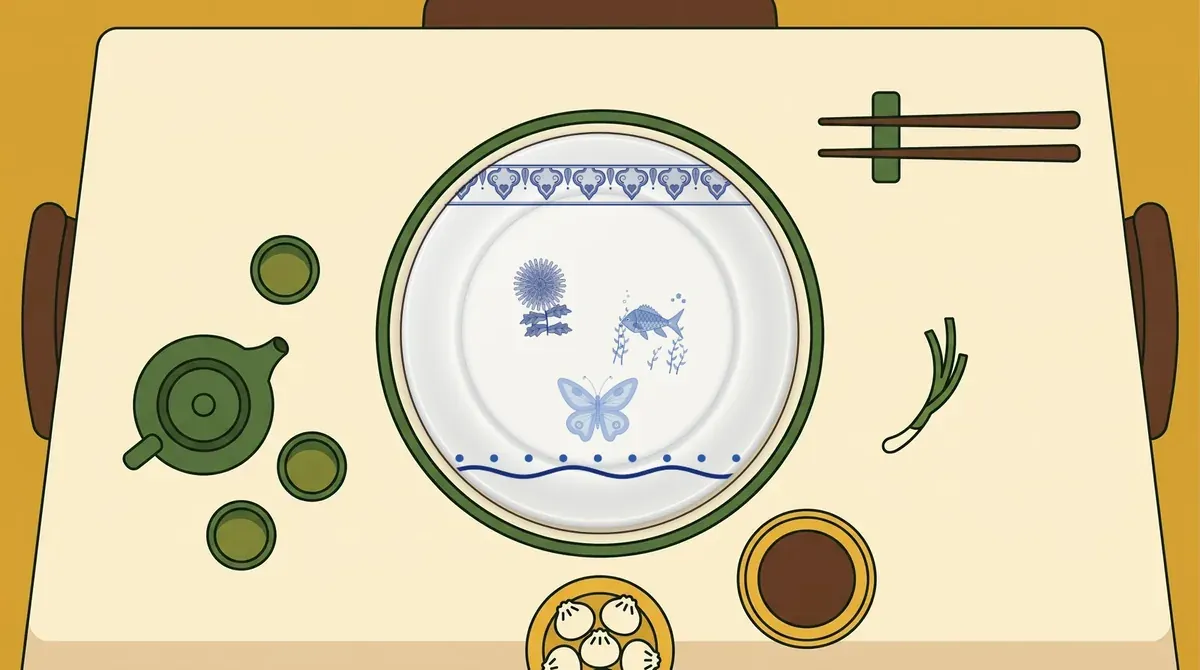
- Place it in a scene: a moon window, a dining table, a display shelf, a sofa cushion.
- Exhibit it: hand it in to the class 3D gallery. See the sample gallery first.

Price
Every studio can be tried first, with a watermark on the result; taking a work home without it is $4.90. To teach, buy a lesson ($12) or the annual pass ($59 a year: every lesson, and every work without the watermark). New accounts get 60% off in their first hour. See pricing
Copyright and labels
- The patterns in the library are drawn by YinSeal. Two "museum sample" patterns are traced from CC0 objects at Cleveland and the Met, credited with museum and accession number.
- The museum photographs are CC0 open-access images.
- Please do not label work made in YinSeal as a product of any museum.
Blue and white porcelain patterns: common questions
- What are the most common blue and white porcelain patterns?
- Main designs include lotus scrolls, peony scrolls, plum branches, the pine-bamboo-plum "Three Friends", fish among water plants and figure scenes. Narrow bands of key fret, lotus petals, waves and ruyi clouds frame the rim, neck, shoulder and foot.
- Why is blue-and-white porcelain blue?
- The patterns are painted in cobalt. Covered with a clear glaze and fired at high temperature, cobalt turns blue, and it is the pigment that could withstand that heat.
- What does the lotus scroll mean?
- The lotus is a symbol of purity, popular with Chinese scholars and in Buddhism. The scroll is a way of linking one blossom to the next with a winding vine, so the design can run all the way round a vessel.
- What does the key-fret border mean?
- We found no reliable source. Museums record it as a "key band", a border, without a meaning. The popular explanation online is not used here.
- Can I use blue and white porcelain patterns in my own designs?
- The museum photographs on this page are CC0 open-access images and may be used freely. The patterns in the YinSeal library are our own redrawings, free to use inside YinSeal. Images on other sites carry their own rights, so check the licence first.
Blue and white porcelain patterns use only two colours but follow plenty of rules: lotus, peony, plum, bamboo and fish each carry a meaning, and main designs and bands each have their place. Pick a blank and put together your first set of blue and white porcelain patterns.
It opens with a blank meiping vase; the pattern library is on the right.
Sources
- Victoria and Albert Museum, Chinese blue-and-white ceramics (read 2026-11-11)
- Asian Art Museum (San Francisco), Lidded Jar with Design of a Lotus Pond (read 2026-11-11)
- Victoria and Albert Museum, Vase, C.995-1910 (read 2026-11-11)
- Victoria and Albert Museum, Flask, C.47-1935 (read 2026-11-11)
- Cleveland Museum of Art, Jar with Lion-Head Handles, 1962.154 (read 2026-11-11)
- Victoria and Albert Museum, Vase, C.66-1935 (read 2026-11-11)
- Cleveland Museum of Art, Prunus Vase (Meiping) with Blossoming Lotus, 1942.716 (read 2026-11-11)
- Cleveland Museum of Art, 1993.10 (read 2026-11-11)
- Cleveland Museum of Art, Bowl with Decoration of the "Three Friends", 1953.631 (read 2026-11-11)
- Cleveland Museum of Art, Ink Plum, 1970.80 (read 2026-11-11)
- Cleveland Museum of Art, Fish, 1977.201 (read 2026-11-11)
- Cleveland Museum of Art, Scepter in the Shape of a Ruyi Fungus, 1970.155 (read 2026-11-11)
- Smithsonian National Museum of Asian Art (Freer), Bowl, F1951.3 (read 2026-11-11)
- Cleveland Museum of Art, Plate with Grapes and Floral Sprays, 1953.127 (read 2026-11-11)
- Victoria and Albert Museum, Dish, 1637-1876 (read 2026-11-11)
- Victoria and Albert Museum, Bottle, C.2370-1910 (read 2026-11-11)
- Victoria and Albert Museum, After Willow, C.302-2009; Plate, C.847-1925 (read 2026-11-11)
- National Palace Museum (Taipei), The Magic of Kneaded Clay: Ming Dynasty (read 2026-11-11)
- Smithsonian National Museum of Asian Art (Freer), Bowl, F1953.1a-b (read 2026-11-11)
- Hillwood Estate, Museum & Gardens, Vase (meiping), 26.262 (read 2026-11-11)
- Cleveland Museum of Art, 2020.189 (read 2026-11-11)
- Cleveland Museum of Art, 2017.20 (read 2026-11-11)
- Victoria and Albert Museum, Vase, C.40-1935 (read 2026-11-11)