Cleveland Museum of Art · 2004.64 · CC0 public domain · museum page
Learn
Yangshao Culture - The Human-Face Fish Basin
Updated 2026-11-12
Yangshao culture was the first prehistoric culture that China came to know through archaeology. It was found in 1921 at Yangshao village in Mianchi county, Henan, and named after it, and scholars widely regard that excavation as the start of modern Chinese archaeology[1]. Its best-known piece of painted pottery is the human-face fish basin from Banpo in Xi’an. This page covers three things: what the Yangshao culture was, where the human-face fish basin comes from, and how painted pottery was decorated. Then you can rebuild the basin yourself, shard by shard.
What was the Yangshao culture?
In October 1921 the Swedish geologist Johan Gunnar Andersson and Chinese scholars including Yuan Fuli excavated at Yangshao village with the Chinese government's permission. In 36 days they opened 17 excavation points and recovered large numbers of pottery and stone tools, along with objects of bone and shell[1]. The village lies in Mianchi county, in the city of Sanmenxia, Henan province[2].
- How old: about 5,000 to 7,000 years[2].
- How widespread: Xinhua calls it the most widely distributed archaeological culture in China, found in 10 provinces and regions and lasting more than two thousand years[1].
- More than one face: at the Miaodigou site, also in Sanmenxia, the lower layer is known as the Miaodigou type and belongs to the Yangshao culture period[2].
The Yangshao culture is famous for its painted pottery: vessels decorated with pigment and then fired. In Chinese it is called 彩陶, literally "coloured pottery".
The human-face fish basin: find, use and museum
We only repeat what has a source. According to China Daily[3]:
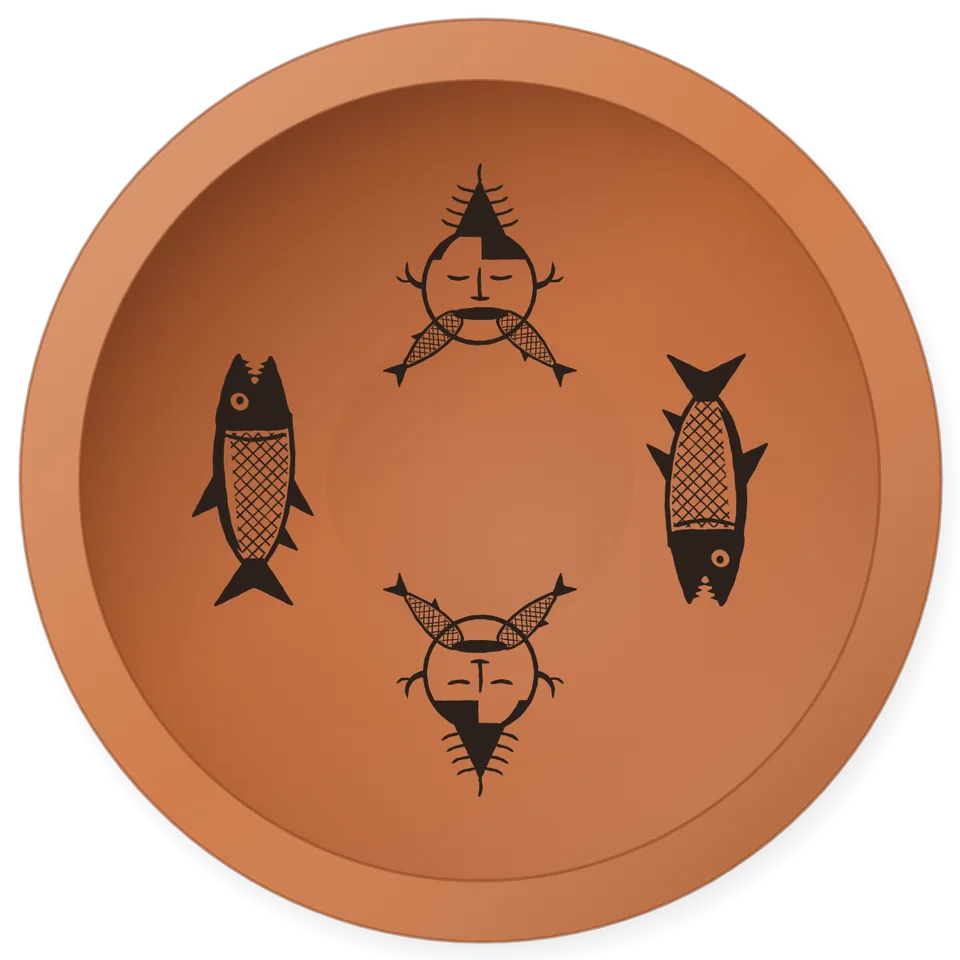
- What it looks like: a red-clay basin painted in black, with two sets of symmetrical human-face and fish patterns on the inner wall.
- Where it was found: excavated in 1955 at Banpo village, Xi’an.
- What it was used for: the lid of a child’s burial pot.
- Where it is now: in the permanent collection of the National Museum of China.
- What it may mean: the report says the patterns reflect totem worship and people’s fishing lives at the time.
Why the faces hold fish, or why the heads are pointed, has no agreed answer, and we do not invent one.
The Banpo site itself is worth knowing. Painted pottery turned up in 1953 while a thermal power plant was being built in Xi’an, and the site was gradually revealed. The Xi’an Banpo Museum was China’s first museum of prehistoric ruins, and the site includes 46 dwellings, 174 adult tombs, 73 burial jars for children and six pottery kilns[4]. The human-face fish basin closed one of those children’s burial jars.
The basin at the top of this page and in the puzzle is an illustration we drew from published descriptions, not a photograph: the museum’s images cannot be used on a commercial site.
How painted pottery was made: Yangshao to Majiayao
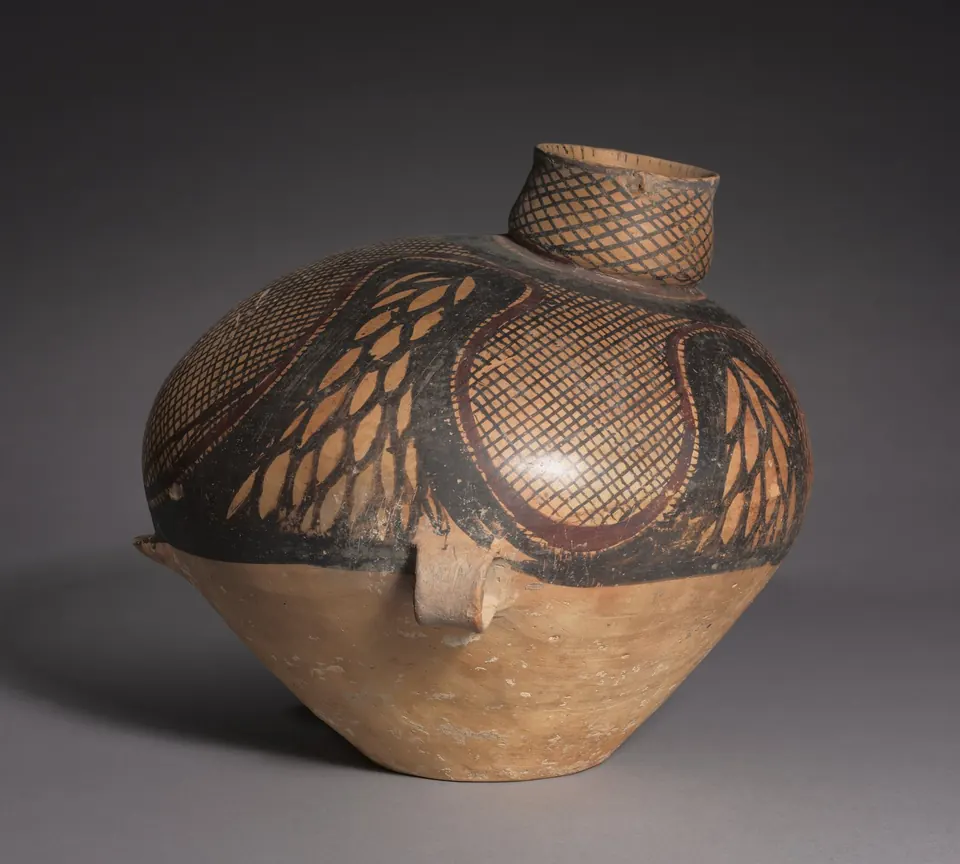
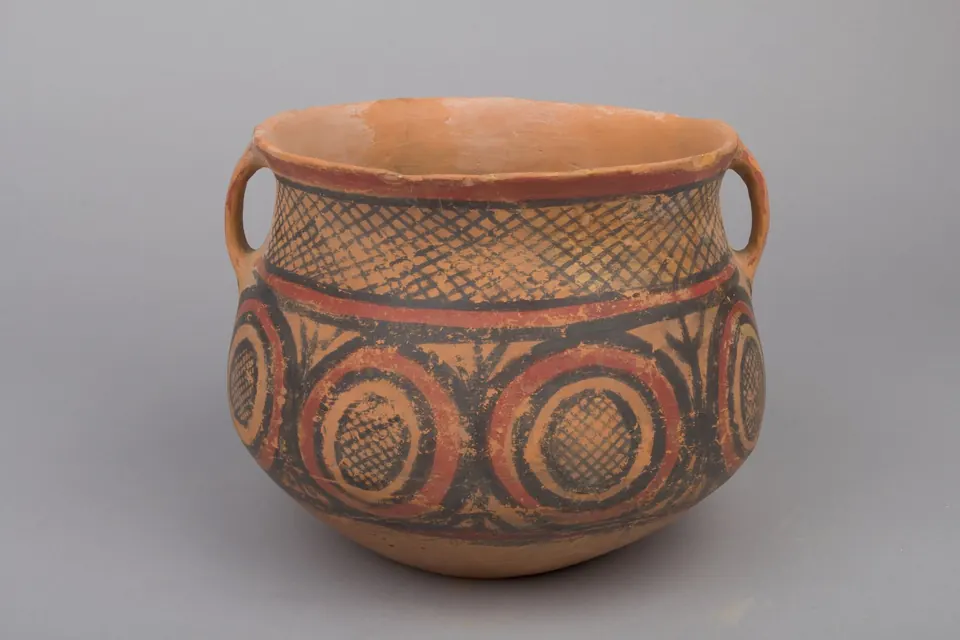
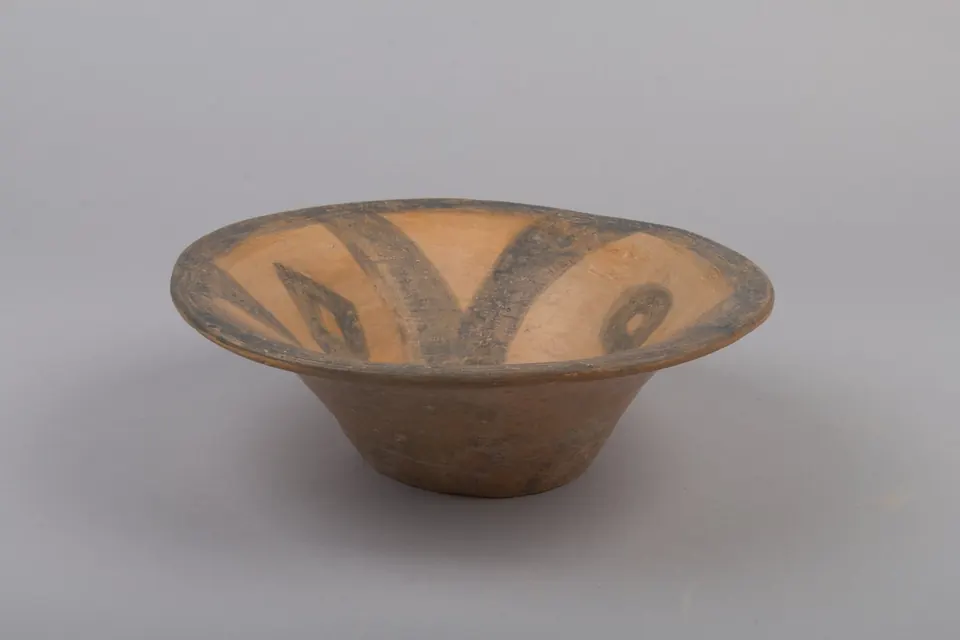
Painted pottery is not only Yangshao. The Majiayao culture of northwest China was "one of the earliest cultures of China", known for "vessels with black-slip painted patterns"[5]. Describing a Majiayao bird-shaped urn, the Cleveland Museum of Art explains the process: iron in the clay fires to a light reddish colour when the kiln gets plenty of air, and the surface was burnished before it was painted in black and red[6].
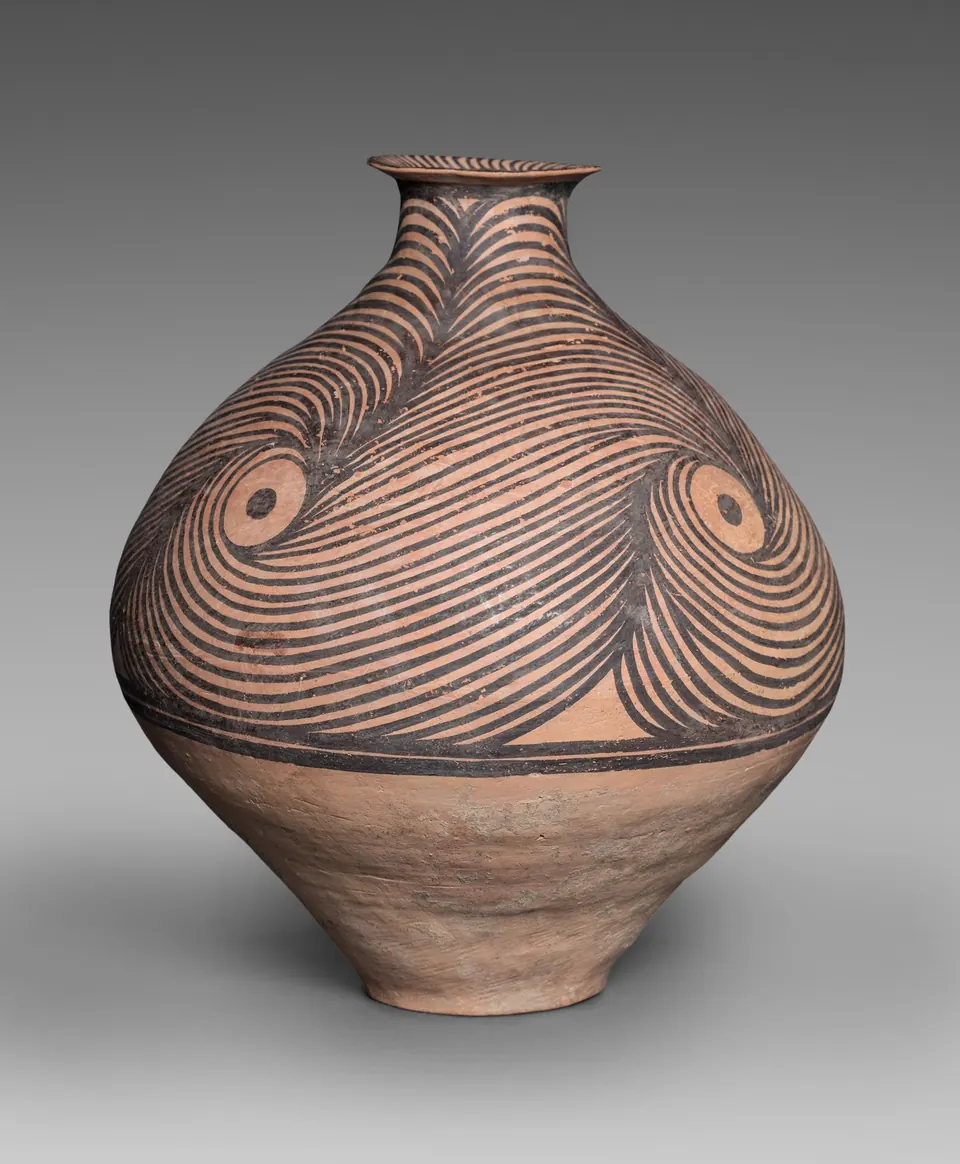
The same museum adds two points about a large Majiayao jar[7]: its geometric patterns are "probably abstract symbols transformed from a bird image", perhaps a clan totem or nature spirits; and archaeology confirms that several regional cultures coexisted in ancient China, "contesting the old belief that the Chinese civilization originated solely along the Yellow River".
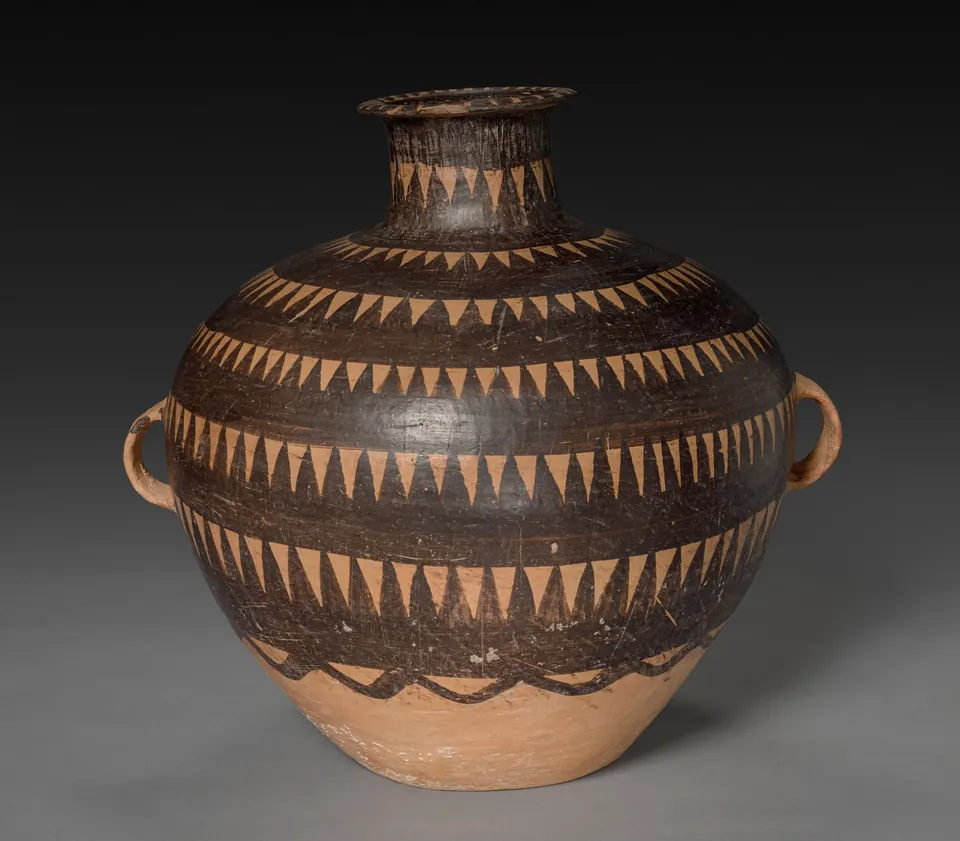
All four photographs below are Majiayao culture, not Yangshao. They are CC0 images from the Cleveland Museum of Art and The Metropolitan Museum of Art:
Yangshao culture motifs: fish, faces, nets and petals
These are YinSeal’s own redrawings in the painted-pottery style, ready to use in the pottery studio. Where a card gives a meaning or an origin, it links the source; where it does not, we found nothing reliable and give the name only.
- Human-face fish (simplified)人面鱼纹(简化)Meaning:China Daily writes that the human-face and fish patterns reflect totem worship and the fishing life of the time. Source
- Fish鱼纹
- Net网纹
- Broad band宽带纹
- Miaodigou petals庙底沟花瓣纹
- Frog蛙纹
- Spirals旋涡纹
- Triangles三角纹
- Spiral eye (from a museum piece)旋心(照片取样)Meaning:The museum suggests the jar’s geometric patterns are abstract symbols transformed from a bird image, perhaps a clan totem or nature spirits. Source
Three things to take from the objects on this page when you paint in the Yangshao culture style: the ground is the natural red of the clay; the designs are mainly black, sometimes with red; and the design goes where it will be seen, which for the human-face fish basin meant the inside. Repeat one motif all the way round and you have a frieze pattern.
Rebuild the human-face fish basin in the archaeology puzzle
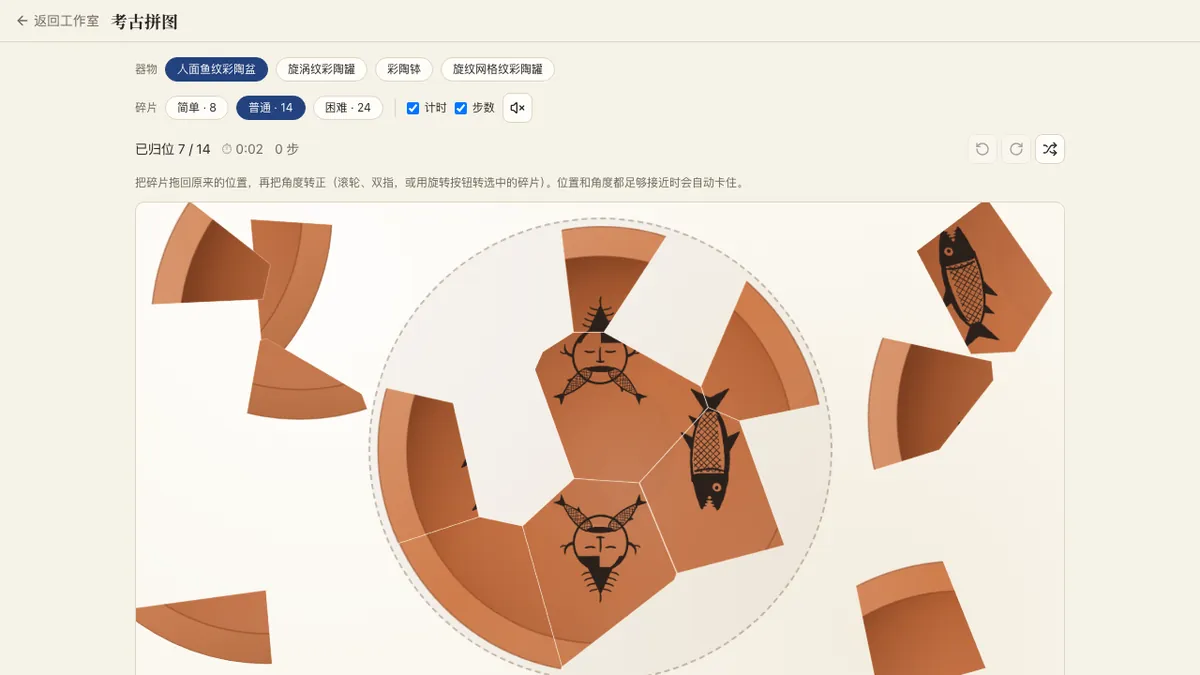
When the basin is whole, numbered points appear on it: the faces and fish, why fish, the Banpo find, and where it is today. All four notes come from the China Daily report above. A class can go like this:
- Rebuild: the archaeology puzzle, then open the four notes.
- Paint: in the pottery studio, choose a blank (basin, bowl, two-handled jar or gourd bottle) and decorate it with fish, nets or spirals.
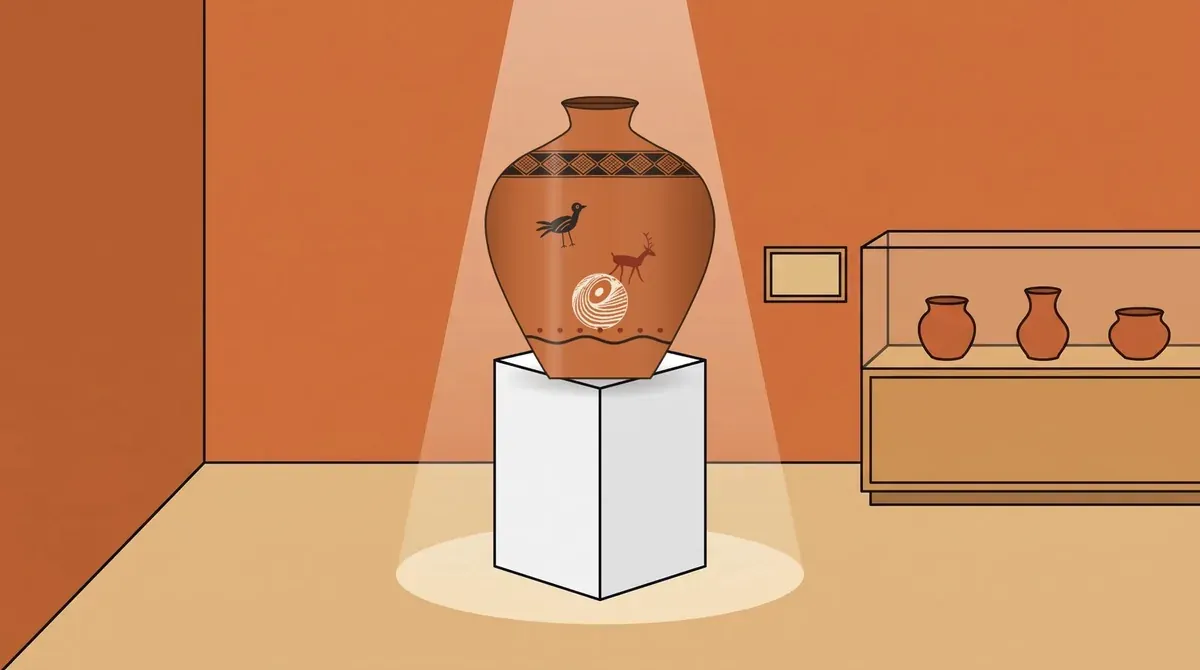
- Place it: put your pot on a museum plinth or in the village scene.
- Exhibit: hand it in to the class 3D gallery. See the sample gallery.
Price
Every studio can be tried first, with a watermark on the result; taking a work home without it is $4.90. To teach, buy a lesson ($12) or the annual pass ($59 a year: every lesson, and every work without the watermark). New accounts get 60% off in their first hour. See pricing
Images and labels
- The human-face fish basin appears only as YinSeal’s illustration; we do not use the National Museum of China’s photographs.
- The Majiayao photographs are CC0 museum images, each labelled Majiayao. None is presented as Yangshao.
- The motifs are our own redrawings in the painted-pottery style, not copies of a particular object.
Yangshao culture: common questions
- How old is the Yangshao culture?
- About 5,000 to 7,000 years old, in the wording of the Henan provincial government. China Daily dates it 5000–3000 BC.
- Where was the human-face fish basin found, and where is it now?
- It was excavated in 1955 at Banpo village in Xi’an, where it had served as the lid of a child’s burial urn. It is in the permanent collection of the National Museum of China.
- What does the human-face fish design mean?
- Nobody knows for certain. China Daily writes that the patterns reflect totem worship and the fishing life of the people at the time.
- Is Majiayao pottery the same as Yangshao culture?
- No, they are different archaeological cultures. Every pottery photograph on this page is Majiayao and is labelled as such; the Yangshao basin is shown only as an illustration.
- Why is there no photograph of the original basin?
- The original is in the National Museum of China, and its photographs cannot be used on a commercial site. We drew our own illustration from published descriptions, and the puzzle uses it too.
The Yangshao culture is more than five thousand years away, yet the human-face fish basin can be "excavated" again in a single lesson: rebuild it, read about it, then paint your own. Start the puzzle and put this Yangshao culture masterpiece back together.
Easy has 8 shards, normal 14, hard 24.
Sources
- Xinhua, 百年筚路蓝缕 勾勒文明脉络 (centenary of the discovery of the Yangshao culture), 2021-10-17, via ifeng.com (read 2026-11-12)
- Henan Provincial People’s Government, Episode II: The Yangshao Site & The Miaodigou Site, 2021-10-24 (read 2026-11-12)
- China Daily, Neolithic painted pottery basin reflects totem worship, fishing life, 2022-07-11 (read 2026-11-12)
- China Daily, Xi’an Banpo Museum, 2018-12-07 (read 2026-11-12)
- Cleveland Museum of Art, Urn with Triangular Patterns, 2017.21 (read 2026-11-12)
- Cleveland Museum of Art, Bird-shaped Urn, 2007.276 (read 2026-11-12)
- Cleveland Museum of Art, Jar with Spiral Designs, 2004.64 (read 2026-11-12)