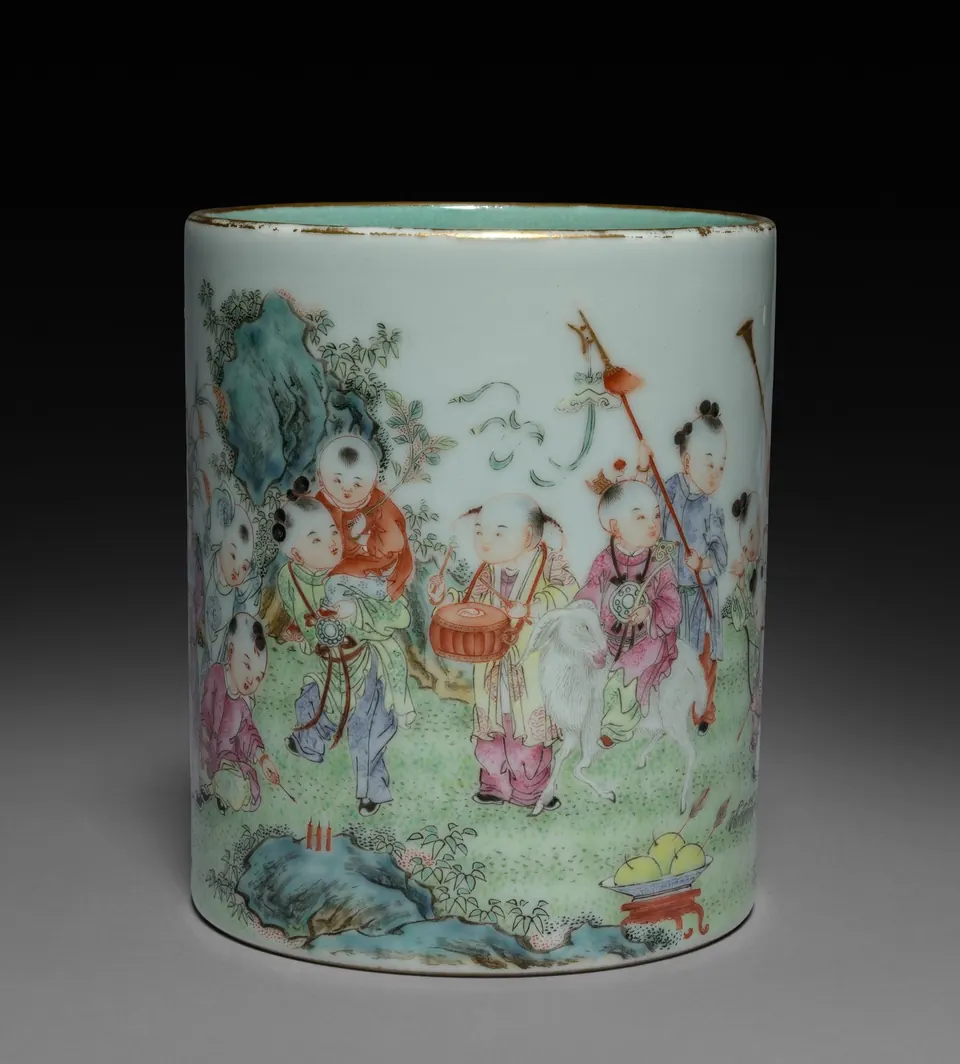
Cleveland Museum of Art · 1944.178 · CC0 public domain · museum page
Learn
Year of the Goat 2027: Dates, Meaning, Art Ideas
Updated 2026-11-12
The Year of the Goat begins on Saturday, 6 February 2027, the first day of the lunar year Ding-wei (丁未) in the Hong Kong Observatory’s official table[1]. If you are planning artwork, a class or a card for it, three questions come up: which dates matter, why English can’t decide between goat, sheep and ram, and what the animal means in Chinese art. Each answer has an official or museum source, and three project ideas follow.
When is the Year of the Goat 2027?
| Date | What happens |
|---|---|
| Thu 4 Feb 2027 | Spring Commences (立春), a solar term[1] |
| Fri 5 Feb | New Year’s Eve. Mainland China’s public holiday runs 5–13 February[2] |
| Sat 6 Feb | New Year’s Day, the first day of the first lunar month[1] |
| Sat 20 Feb | Lantern Festival, closing the season[1][3] |
| Wed 26 Jan 2028 | Year of the Monkey begins, so the goat year runs to 25 January 2028[4] |
The new moon that starts the year falls at 15:56 Universal Time on 6 February[5]. That is 23:56 in Beijing, four minutes before midnight; the same new moon brings an annular solar eclipse[6]. Chinese New Year always falls between 21 January and 20 February[7]. The previous year, the Horse, began on 17 February 2026[8].
A detail for zodiac or birthday pieces: official calendars change the year’s name on the first day of the first lunar month, while fortune-tellers often use Spring Commences instead[9]. In 2027 the two dates are two days apart, so someone born on 4 or 5 February 2027 can be told either the Horse or the Goat.
Ding-wei: how 2027 gets its name
The Chinese calendar names years with pairs drawn from ten heavenly stems and twelve earthly branches; each year takes one pair, and the cycle repeats every 60 years[10][9]. Ding is a stem and Wei is a branch[10], and the Observatory’s 2027 table pairs Ding-wei with the Goat[1].
Each year is also linked to one of five elements[11]. The popular label "Fire Goat" for 2027 appears in no official calendar or museum source we checked, so we leave it out.
Year of the Goat, Sheep or Ram?
All three are defensible. In Chinese, goats and sheep share one word, 羊 yáng[12]. English has to choose, and institutions choose differently:
- The Hong Kong Observatory: "year of the Goat"[1].
- Britannica’s zodiac table: "sheep" for 2027[13].
- The Asian Art Museum in San Francisco: "Year of the Ram" on its zodiac coloring sheets[14].
- The Cleveland Museum of Art: its set of 6th-century zodiac figures says "goat" in the description but titles one figure "Sheep"[15].
For a poster or a class, pick one word and use it consistently. On YinSeal this is the Year of the Goat, and the studio’s curly-horned picture seal of the animal is labelled Goat too.
The goat in Chinese art: what museums document
Only meanings we could trace to a museum or a primary text are given here.
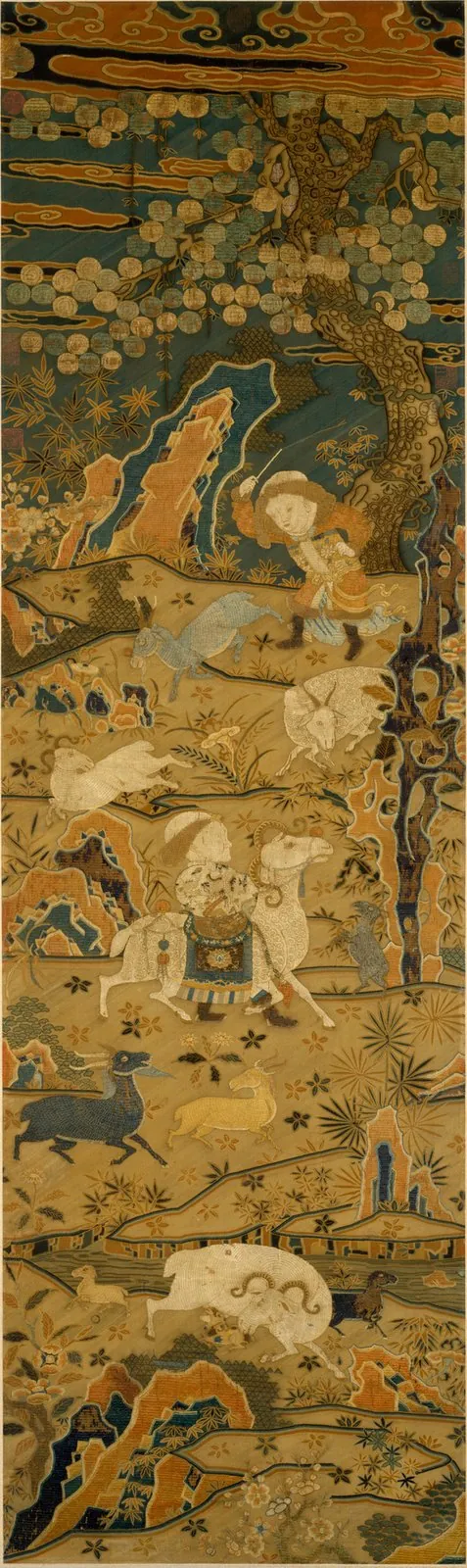
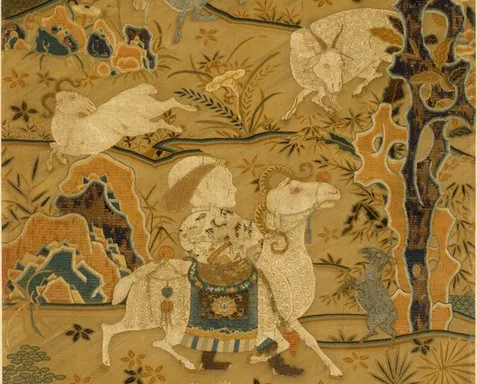
Three goats for spring. 羊 yáng sounds like 陽 yáng, "sun"[12]. The Metropolitan Museum’s 15th-century embroidery Welcoming spring repeats three goats to call up 三陽開泰 sanyang kaitai, "three suns welcome spring", which the museum describes as "a wish for an auspicious new year taken from the ancient Book of Change"[12]. A Freer Gallery label adds that, because the New Year is associated with spring, "sheep are commonly used to symbolize blessings for the coming New Year"[16].
A word close to "auspicious". The ancient dictionary Shuowen jiezi glosses 羊 as 祥, "auspicious"[17]. The Nelson-Atkins Museum makes the same link for a Western Han bronze lamp in the form of a ram: "The Chinese word for ram is a near homonym for ‘auspicious.’ Rams were therefore frequently depicted in Han Dynasty art."[18] The National Museum of China says the same of a sheep-shaped celadon candlestick from the Three Kingdoms state of Wu (222–280)[19].
Rams in bronze. The Four-Ram Square Zun is a Shang dynasty bronze found in 1938 at Huangcai, Ningxiang, in Hunan. It stands 58.6 cm tall and weighs 34.6 kg; its shoulders, body and feet form four curly-horned rams, one at each corner, and the National Museum of China calls it the largest surviving Shang square zun[20].
A goat at New Year. The porcelain brush holder at the top of this page, in Cleveland, shows a goat next to a boy "about to ignite fire crackers lined up on a stone, a custom to celebrate the New Year"[21]. The museum’s date is uncertain: "1736–95 or later, mid-1800s?"
What we left out: zodiac "personality traits", which are astrology, and the claim that Han inscriptions wrote 吉祥 as 吉羊, which we could not confirm.
Year of the Goat art ideas
Each takes 20–40 minutes in the browser.
1. Carve your name as a seal
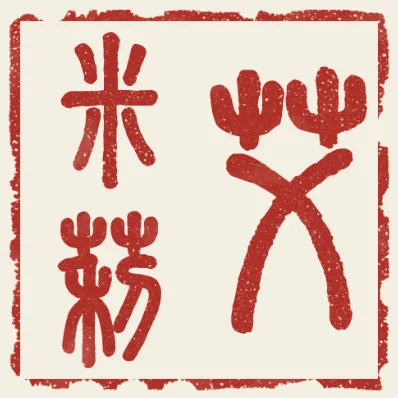
Chinese seals have long been used to sign art, letters and documents, and collectors stamp the works they own[22]. In the YinSeal seal studio, type your English name and choose from its usual Chinese renderings. Each character comes with its pinyin and a plain meaning, so you know what you are carving. Choose red (zhuwen) or white (baiwen) characters and a shape, then stamp the seal on anything you make.
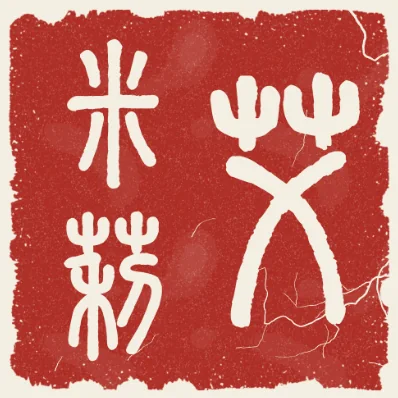
Type an English name, pick its Chinese rendering, then carve it in red or white characters.
2. Paint a blue-and-white New Year plate
Pick one person and one wish. A fish is a pun: 魚 yú sounds like 餘 yú, "abundance"[23]. Three goats, drawn with the brush, carry the "three suns" wish. Paint in three values of cobalt, stamp your seal as the maker’s mark, and set the plate on the dinner-table scene.
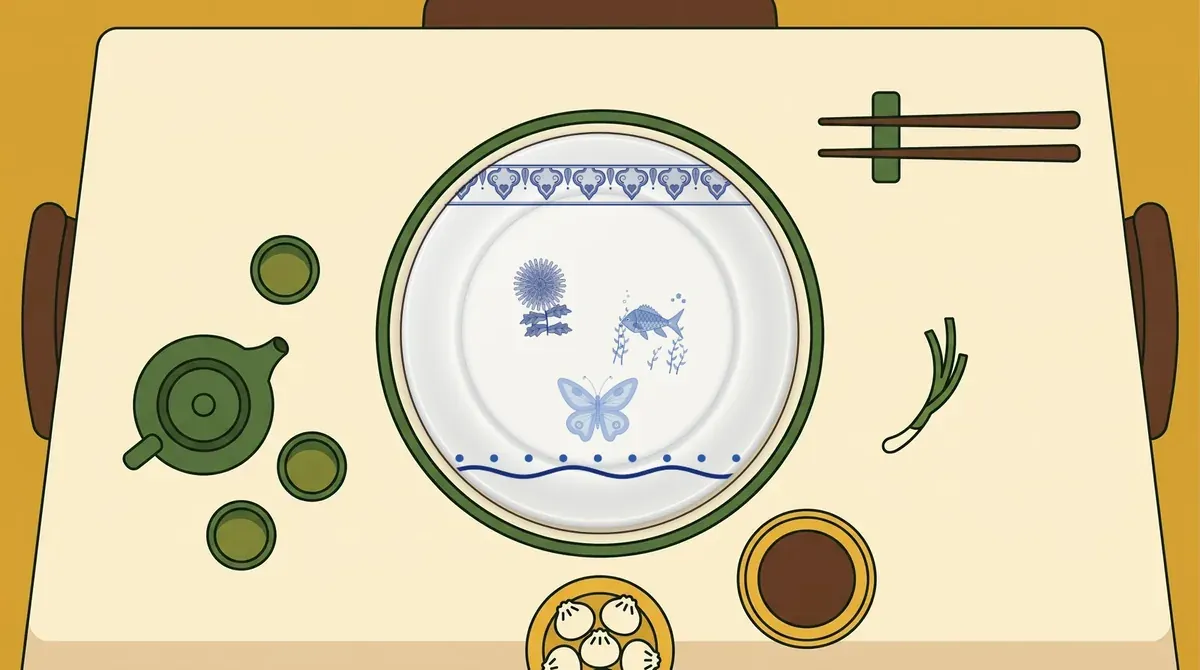
Start from the plate blank in the blue-and-white studio.
3. Use a goat picture seal
Not every seal carries words. The studio’s Goat picture seal is a curly-horned animal in a square frame; use it beside your signature or as a repeated motif. Han seal makers worked animals into the seal itself: seals with "tortoise, chimera, ram, and camel-shaped knobs were popular and have been excavated from Eastern Han tombs"[24].
- Goat (red)肖形印·羊(吉祥)(朱文)Meaning:The ancient dictionary Shuowen jiezi glosses 羊 (goat) as 祥, "auspicious". Source
- Goat (white)肖形印·羊(吉祥)(白文)
Teaching the Year of the Goat
For instructors, the Lunar New Year 2027 art lesson turns these ideas into one 75–90-minute class or a 3-hour studio. Students carve a name seal, design a gift plate that carries one wish, stamp the seal on it, and hand both in to a class 3D gallery without creating accounts. For the motifs on the plate, see blue-and-white porcelain patterns; for the seal itself, the Chinese name seal guide.
Year of the Goat: common questions
- When does the Year of the Goat start in 2027?
- On Saturday, 6 February 2027, the first day of the first lunar month. It ends on 25 January 2028; the Year of the Monkey begins the next day.
- Is 2027 the Year of the Goat, the Sheep or the Ram?
- All three appear in reputable sources, because 羊 covers both goats and sheep: Goat (Hong Kong Observatory), sheep (Britannica), Ram (Asian Art Museum).
- Is 2027 a Fire Goat year?
- The label is common online, but we found no official calendar or museum that uses it. Officially, 2027 is Ding-wei, the Year of the Goat.
- What does the goat symbolize in Chinese art?
- Two links are documented: 羊 sounds like 陽 "sun", so three goats mean "three suns welcome spring"; and 羊 is close to 祥 "auspicious".
Whichever English word you choose, the Year of the Goat gives you a documented set of images to work with: three goats for spring, a near-pun on "auspicious", and a seal to sign what you make.
Sources
- Hong Kong Observatory, Gregorian-Lunar Calendar Conversion Table of 2027 (Ding-wei, year of the Goat) (read 2026-11-12)
- General Office of the State Council, notice on the 2027 public holidays (Xinhua) (read 2026-11-11)
- Encyclopaedia Britannica, Lantern Festival (Internet Archive copy) (read 2026-11-11)
- Hong Kong Observatory, Gregorian-Lunar Calendar Conversion Table of 2028 (Wu-shen, year of the Monkey) (read 2026-11-12)
- NASA GSFC (F. Espenak), Phases of the Moon: 2026 to 2030 (read 2026-11-11)
- NASA GSFC (F. Espenak), Solar Eclipses: 2021–2030 (read 2026-11-11)
- Encyclopaedia Britannica, Chinese zodiac (Internet Archive copy) (read 2026-11-11)
- Hong Kong Observatory, Gregorian-Lunar Calendar Conversion Table of 2026 (Bing-wu, year of the Horse) (read 2026-11-11)
- Hong Kong Observatory, What year is it today? (read 2026-11-11)
- Hong Kong Observatory, Heavenly Stems and Earthly Branches (read 2026-11-11)
- Library of Congress, Celebrating Lunar New Year with the Library of Congress’s Collections (2024) (read 2026-11-11)
- The Metropolitan Museum of Art, Welcoming spring, 1981.410 (Internet Archive copy, 2026-04-14) (read 2026-11-11)
- Encyclopaedia Britannica, Chinese New Year, zodiac table (Internet Archive copy) (read 2026-11-11)
- Asian Art Museum (San Francisco), Lunar New Year Zodiac Animals: Coloring Pages (PDF) (read 2026-11-11)
- Cleveland Museum of Art, Mortuary Figures of the Zodiac Signs, 1972.76 (read 2026-11-11)
- Smithsonian National Museum of Asian Art (Freer), Sheep and shepherd-boy under a willow, F1909.244e (read 2026-11-11)
- Shuowen jiezi, 羊部 (Wikisource transcription) (read 2026-11-11)
- Nelson-Atkins Museum of Art, Lamp in Form of a Ram, 35-218 (read 2026-11-12)
- National Museum of China, 青瓷羊形烛台 (sheep-shaped celadon candlestick) (read 2026-11-12)
- National Museum of China, 四羊青铜方尊 (Four-Ram Square Zun) (read 2026-11-12)
- Cleveland Museum of Art, Cylindrical Brushholder, 1944.178 (read 2026-11-11)
- Virginia Museum of Fine Arts, Create a Chinese Seal (Internet Archive copy, 2025-03-18) (read 2026-11-11)
- Minneapolis Institute of Art, seal, 2000.38.6 (read 2026-11-12)